
You are wherever your thoughts are, make sure your thoughts are where you want to be.” — Rebbe Nachman of Breslov
Over the years my wife, children, and students will tell you about my theory about expectations —if you enter into something with a certain mindset —such as low expectations, you will never be disappointed. The simplest application of this is the movies. Go to a blockbuster movie with high expectations, you may be disappointed, go in with low expectations, rarely disappointed.
Keeping that in mind, have you ever felt like there were times when what you expected to happen did not happen and you got the opposite? Like if you expected things to go smoothly, yet it was a mess. Or if you worried about something and stressed over it, and then it ended up going fine. Mindful thinking has been something I have been working on for a long time. Neuroscience continues to show us how one’s daily experiences and our brains are interconnected. It can be uplifting to know that we can actually make physical changes to our brain through our thoughts and feelings. As I am always fond of saying: do something different, and/or think something different, and you will feel something different. That is guaranteed. How long does it take? Will it be better than how I feel now? I don’t know the answer to either of those questions —I just know it will be different.
I recently came across a quote by R. Samuel b. Nahmani, “A man is shown in a dream only what is suggested by his own thoughts…”. It made me think about my theory on expectations, similar to the quote by R. Nachman of Breslov; was Nahmani saying: if what we see in our dreams is suggested by our thoughts, might not what we see, or choose not to see in our so-called waking states also be influenced by what and who we are? After all, as the popular saying goes, “We do not see things as they are. We see things as we are.”
Here’s a visual that might better explain.
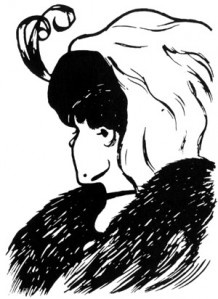
The famous image above shows the profile of an old woman, or a young woman, depending on how you look at it. Which one do you see? Can you see both? How we perceive things depends on our life history, our culture, and our deep belief systems commonly referred to as our mental models. And when we have a deeply seated mental model, we tend to see life through that lens. Not the way the world is, rather how we believe the world should be.
Imagine we see a sign that says, “Fine for Parking”. If we saw the world as a warm friendly place, we might park there, thinking that it was very thoughtful for someone to mark that parking space for us. If we were a more fearful person, we might avoid parking there, lest we get a ticket!
Our worldview influences what we see and the meaning we make from it.
And, so it goes. What we tend to see outside ourselves reflects what is inside ourselves. And mere data has little effect on our mental models —we see what we see, and we will not let mere facts get in the way. We love one political candidate and despise another and cannot possibly understand how our friends could vote for the other side. We may hold tight to particulars on an issue, or on a valence issue, and totally reject another point of view. Rejecting another’s worldview is not for a lack of willingness to see a different POV, although sometimes it is, I mean quite literally being unable to understand how our friends could see something entirely different. Inattentional blindness is a real thing and while similar, this is more basic. “Seeing is believing” as the old adage goes, and do we always see, when we look? Seeing may be believing, and more often believing influences what we see. We tend not to see things the way they are —we see them as we are.

______________________________
Rebbe Nachman of Breslov, also known as Reb Nachman of Bratslav, (April 4, 1772 – October 16, 1810), was the founder of the BreslovHasidic movement. Rebbe Nachman, a great-grandson of the Baal Shem Tov, breathed new life into the Hasidic movement by combining the esoteric (obscure and only understood or intended to be understood by a small number of people with special knowledge) —secrets of Judaism (the Kabbalah) with in-depth Torah scholarship. He attracted thousands of followers during his lifetime and his influence continues until today through many Hasidic movements such as Breslov Hasidism. Rebbe Nachman’s religious philosophy revolved around closeness to God and speaking to God in normal conversation “as you would with a best friend.”


Leave a comment