
Does there have to be marital conflict? It’s fair to say conflict in marriage is inevitable, and it is perfectly normal. Marital conflict is a part of life. One of the oldest and most traditional of the marital vows consist of the famous words, “for better, for worse, for richer, for poorer, in sickness and in health. They are an expression of a couple’s intent to be there for each other regardless of the circumstances. No matter what. Obviously someone wise realized that conflict is an unavoidable part of life, and therefore, a part of a couple’s “happily ever after.”
Regardless of the vows, the promise, John Gottman, Ph.D says “it’s a myth that if a couple solves their problems, they will automatically be happy, and it’s important to remind married couples that they will never solve most of their problems.” Ouch! Furthermore, Gottman believes the key to a happy marriage isn’t to eliminate all conflict. “Although we tend to equate a low level of conflict with happiness, a lasting relationship results from a couple’s ability to manage conflicts that are inevitable in any relationship.” Because of this, gaining the skills and developing the ability to successfully navigate conflict becomes critical in creating happiness and harmony in one’s marriage. It also be the best gift we can give to children and our society.
In part 1 of this essay, under this same title, I compared the inability to satisfy one’s needs in a marriage to an inability for a society to deal with conflict, as well. And, as a result of not being able to manage marital discord, it can negatively impacts children who will, later become the grown-up members of society. Thus, the break down. Marital conflict managed well can also be the build up. No matter the continued education, a pattern of not dealing with conflict is commonplace. Yes, some do it well, others could use some practice, lots of practice, and the results can be beneficial to their own relationships and society alike.
In an attempt to fuse ancient wisdom, sages, and elders of contemporary times and modern psychology, I am finding new sources of inspiration every day. One belief system, Judaism, is getting ready to celebrate the holiday of Shavuot. As succinct as I can make it, the holiday marks the completion of the seven-week journey from the exodus of the Jewish people from Egypt to the point where they arrive at Mt. Sinai with an open heart and an open mind, ready to receive the Torah.
The parable of wandering, sometimes seemly endlessly in the desert is common in today’s society, especially after recognizing being a slave to something, perhaps an addiction, a bad relationship, or a challenging situation. Metaphorical, indeed. In one’s life, finally being able tomescape that which binds us is followed with — now what? As the story in the Hebrew Bible goes, the Jews were led to the Promised Land by Moses and his siblings Miriam and Aaron, who despite putting in all the groundwork for their celebrated collective arrival, never actually made it to the Promised Land themselves. What a bummer. Some attribute this unfortunate fate to a “Simon Says” style punishment, wherein God (playing “Simon”) “eliminated” Moses for striking, rather than speaking to (as instructed), a stone to bring forth water. Confusing to say the least. Makes me wonder if they said to themselves “we did what you told us to do, and now we don’t get the reward”. Not only that, we are being punished!
However, according to a famous midrash (biblical story), the seeming tragedy of Moses and company’s doomed death in the Sinai has another explanation. Per this parable, God deemed all the Jewish elders born into slavery in Egypt ineligible to enter the Promised Land because their worldviews were so shaped by the trauma of their origins that they literally needed to die off in the desert so that the next generation, born free, could settle Canaan from a place of freedom. While this tale might be considered problematic on many levels today, it also carries a resonant observation: that the seeds of our past conditioning grow within us.
From self-fulfilling prophecies to cycles of abuse, the lessons that we learn and the norms and expectations we absorb early on tend to stick with us until enough time passes or we actively work to unlearn them—and, even then, long-ingrained patterns can be difficult to change.
Nonetheless, there are some who put stock in the efforts they make and the steps they take towards healing themselves and their communities in this lifetime. In order to do so, it can help to be honest and compassionate with ourselves, to get our needs met, to learn how to communicate; and to reflect regularly on where we came from — our family of origin, to work on understanding our family, and where we are heading—and how. That’s forty years worth? That could take a lifetime? Yes. Learning to manage inevitable conflict, and coming to the realization that it is not possible to eliminate it altogether. Refrain: you make it sound so simple. Yes, and it is not easy, and managing those expectations is doable.
Sources for relationship advice are everywhere and John Gottman, who I refer to as a modern day sage ranks among one of the most influential psychologists to assist in this pursuit. Putting his ideas in words was not so simple. Furthermore, relating them to the wisdom of the ancient sages and putting them to the test inspired me to write and research this post.
Meeting our partner’s needs as we meet our partner’s needs merge to become the needs in the relationship. Huh? Stay with me. Just like a society that meets the needs of its members have an opportunity to merge in order to become a a healthy society. But, I digress a little. I am both realistically and metaphorically looking at marital relationships – considering the inevitable arguments and conflict – Gottman’s sees the ability to have successful navigation of these all-to-common behaviors as a deal-maker or a deal-breaker. His ideas, my words. Does it have to be a deal-breaker?
Arguments about something are almost never about the “thing” argued about. An argument about dishes in the sink is not about dishes in the sink. An argument about who is doing the laundry is not really about the laundry. The dishes, the laundry — they represent something else. Been there? Yeah, me too. Take a moment. Add your own conflicts or arguments with your significant other. There are bound to be a few. They are stand-ins for a deeper issue, an issue that lies beneath the surface. Teaching intercultural communication for many years, i always started with the metaphor of the cultural iceberg. What lies beneath the surface of what we can see is not all there is to see.
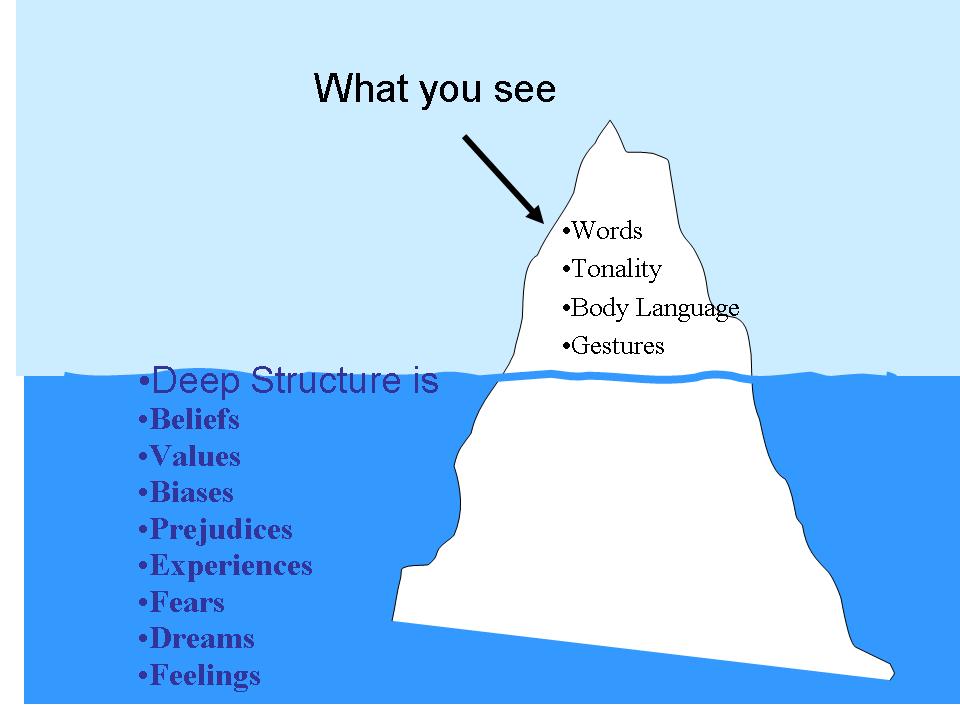
Conflict may also lay under the surface. conflict. The immediate causes for the conflict may not be visible, it may be hidden. Individual couples may know there is something wrong, maybe they profess to know what it is, or suspect what it might be, and they don’t want to address it. Instead, they have this argument about who is responsible for cleaning the kitchen or whose turn it is it to take care of the dog, or getting ever closer to the “real” and then there is the tendency to wonder who dropped the ball in the communication. They may look for blame. Likewise, who is responsible for dropping the ball that is occurring in society, the gun violence for instance. Nope, now now. Not the right time, or is it. Back to conflict among couples.
People in relationships know the argument or the conflict is not really about this or that. Or, do they? If they really are at their wits end, may be it might be worthwhile to speak with a professional. Perhaps one partner is treading water: addressing symptoms rather than looking at the causes of the disease, or as I like to refer to it – the dis-ease. Meanwhile the dis-ease keeps coming back when temporary fixes or bandaids are applied. My experience as a professional counselor is that what often happens in all relationships, not only marriages, it is far easier to address what is on the surface rather than to speak about the deeper and often times more difficult conflict.
One reason is that conversations dealing with arguments or conflict feel risky. They might very well be risky. Most people crave connection with their partner. They fear what might happen if they assert their needs with more boldness and conviction, if they dare to challenge the current status quo in their relationships. Will that open up a proverbial can or worms? Will it disturb the ant bed, or poke the bee hive, or worse, poke the bear. The truth is that it prevents partners from the intimacy required in healthy relationships. And a common refrain: what if my partner becomes hostile when I try to talk? No question – relationships are a hotbed for emotions that can be easily awakened in conflict. One of the simplest tools is to simply pause. Come on, is that the best you got? It’s so simple, just not easy, and not always effective. Fine. Let’s go dive deeper under the iceberg.
Be it sage advice, or Dr. John Gottman’s, the suggestion is to go ahead and have that deeper conversation. Open with love and kindness and care what lies beneath the surface. Bring concerns forward so that the real reason for the conflict can be seen, and addressed. Get it out in the open. In order to heal, we must be able to feel. Open and honest conversations can go a long way towards “having a healthy you,” although there is no set time limit on how long it might take, and it certainly beats a negative outcome. Will it work? Better than doing the same thing over and over again expecting different results. Do something different, feel something different! Again with the will it be better? Can’t say. And for some, after a few failures, they just stopped and accepted that’s just the way it is.
Emotional pain cannot kill you, but running from it can. Allow. Embrace. Let yourself feel. Let yourself heal.”
Vironika Tugaleva
Being able to first fully-acknowledge your own needs, and how the relationship may not be meeting them requires trust, safety, and the actionable item (that verb, not the noun — love) — be loving, being open to listening to the other person, to hear and understand their needs — it can go a long way. It is imperative to consider that our needs also may not be met. It is both simple and at the same time, not easy, and if you are use to always getting your way -that can be a problem. Are relationships suppose to work that way? Open conversations can be an invitation to examine one’s own beliefs, assumptions, attitudes, and expectations of their partner.
Internal questions might include: Where am I being unrealistic or unfair? Where am I expecting too much or too little? Where am I holding the other person to a standard that is too high or too low? Where am I overcompensating for what I perceive to be my significant other’s deficiency, thereby over-giving at my own expense? Is this preventing a closer connection, thereby draining vital energy away from me, and disrespecting, myself and my partner?
Is there a need for restraint in what’s shared? Or perhaps the better question might be, what to hold back. Well, the discussion up to this point is — not to hold back. Perhaps it is more poignant to say: what not to hold back. The answer the sages reveal is resisting the urge to render judgment on the relationship at the wrong time. Timing is a crucial consideration as is suspending judgement.
One’s partner may not be at ease. They may be distracted, or too emotional, which inhibits one’s ability to operate at full capacity. As we decrease our emotionality, we are better able to think clearly, which has the added component of being able to converse calmly. Yes, not so easy. Consider if we, or our partner is in fight-or-flight mode, it can shut down the conversation, rendering our own inattention to the needs of our partner in trying to satisfy their needs. In this state, too much emotionality might render them or you with an inability to hear or appreciate concerns. What if the time never presents to have a calm discussion? Yes, a real concern. That might be the very thing a couple needs to discuss.
Knowing when to initiate a conversation can be crucial. If one partner initiates at the wrong time, they risk further resistance and rejection. It helps to be reminded that to respect the other person’s space is not to force conversations before their time. The metaphor of a society having dialogues when people are not ready cannot be emphasized enough. While solutions to problems may not be immediate, in the long-run, having them are certainly better than continued dissatisfaction, frustration and hurt. When emotions are running particularly high, might seem the best time. Is it? What has been your experience in your relationships about managing conflict when emotions are high?
See if remaining calm and having the important conversations, holding back judgement, not simply holding back, in the most important relationship – the one you are in, and seeing for yourself if that be translated to societal conflict. At the least, be smart about how we are handling conflict, for the sake of the next generation. Are we going to need to wander for another forty years? Are we not going to be let in to the promised land because we struck a rock, rather than speak to it. Professor, I have been ask or told, you sure are expecting a lot. Yes, I am. It may not matter to all the proverbial starfish out there – and to the one being attended to – it can make all the difference. You may have heard the starfish story before, and I find that it doesn’t hurt to be reminded of it every once in a while. My favorite version goes like this.
Once upon a time, there was an old man who used to go to the ocean to do his writing.
He had a habit of walking on the beach every morning before he began his work. Early one morning, he was walking along the shore after a big storm had passed and found the vast beach littered with starfish as far as the eye could see, stretching in both directions. Off in the distance, the old man noticed a small boy approaching. As the boy walked, he paused every so often and as he grew closer, the man could see that he was occasionally bending down to pick up an object and throw it into the sea.
The boy came closer still and the man called out, “Good morning! May I ask what it is that you are doing?”The young boy paused, looked up, and replied “Throwing starfish into the ocean.
The tide has washed them up onto the beach and they can’t return to the sea by themselves,” the youth replied. “When the sun gets high, they will die, unless I throw them back into the water.”The old man replied, “But there must be tens of thousands of starfish on this beach. I’m afraid you won’t really be able to make much of a difference.”
The boy bent down, picked up yet another starfish and threw it as far as he could into the ocean. Then he turned, smiled and said, “It made a difference to that one!”
adapted from The Star Thrower, by Loren Eiseley (1907 – 1977)
Will “we” educate (through example) the leaders of tomorrow to get it “right,” and if so, maybe that has to be enough. We are the adults in the room, and while we might not be as adept at understanding the full extent of conflict, or the impact it had on the children when they were younger and we can work on it. We can learn to manage our own marital discord, and practice “merging” the needs of the relationship, not just our own needs, with our significant others. Don’t fret. Consider the enormous gift we, as parents, as partners, and as a society, can give to the next generation. And, there is a benefit to ourselves, those that can be derived in our own relationships. It’s not so complicated, in fact it’s simple, just not necessarily easy.
 Confessions of a Cowtown Culturalist

Leave a comment