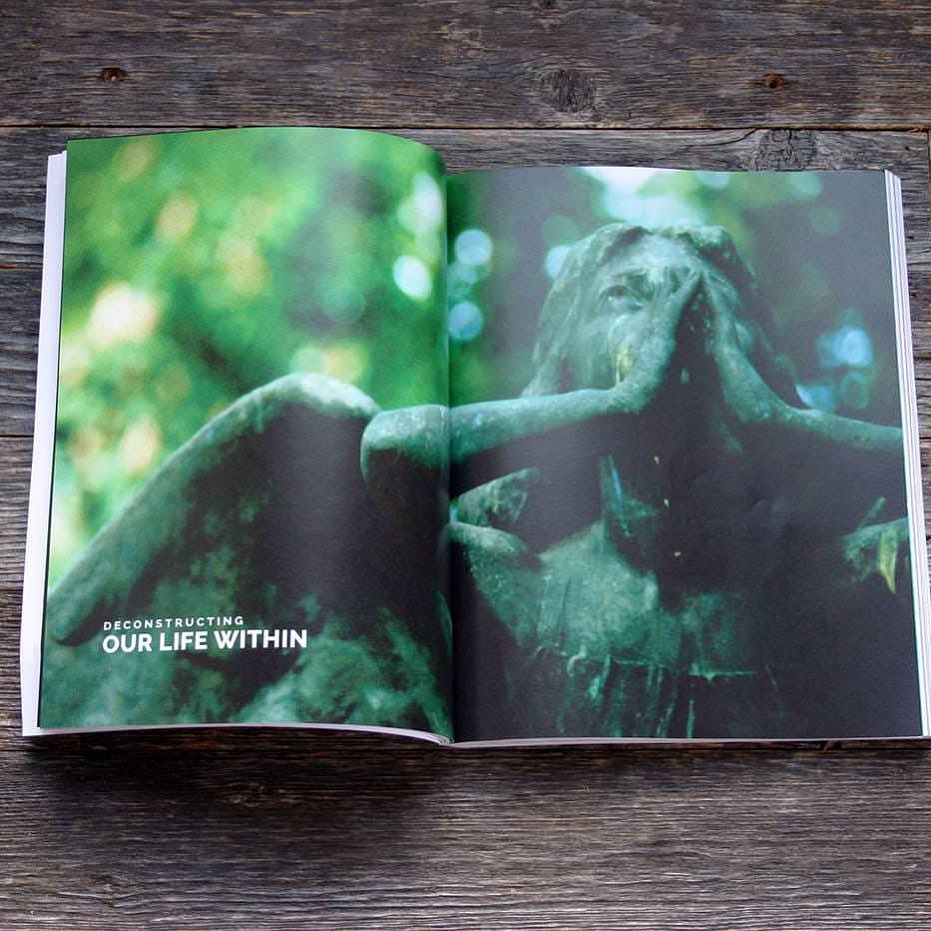
Inspiration can come in the strangest of ways and places. These days I am obsessed with Viktor Frankl, of blessed memory, and other existential and humanistic theorists. Reflecting on the meaning of life at a deep level, I came across the following words by Paula D’Arcy. It resonated with me.
“God comes to us disguised as our life.”
Paula D’Arcy wrote those words after a drunk driver killed her husband and one-year-old child, when Paula was just 27, and three months pregnant.
Sam Radford, in a thoughtful essay wrote: I like the idea of finding God in the wonder of creation, the eloquence of a poem, or the beauty of a song. It’s also easy for me to picture myself finding God through reading the Bible or in an inspirational book.
In essence, I like the idea of finding God out there or away from me and my life. But what if God is far closer to home? What if God is most powerfully and clearly to be found in the midst of my messy, broken, exhausting, hurting, sinful life?
Perhaps it is in times of suffering that people discover the most about themselves and about God. This is one way to understand or interpret Paula D’Arcy’s phrase. And, of course there are other ways. Frankl witnessed a transformative period in world history, and has always been a source of inspiration.
Being a curious one, I went back and re-read Frankl’s Man’s Search for Meaning. According to Frankl, meaning in life can be discovered in three different ways: 1) by doing a deed; 2) by experiencing a value; and/or 3) by suffering. It was this third way that struck a chord. Challenges makes one stronger. Frankl said, “if there is meaning in life at all, then there must be meaning in suffering.” Once a person finds a meaning in what they are going through, then it is no longer suffering. He argued that life can have meaning even in the most miserable of circumstances and that the motivation for living comes from finding that meaning. He believed that people could find hope in even the darkest of places and that a person’s motivation for life comes from meaning. Frankl postulated that this is the core of the human spirit. If someone could find something to live for – some meaning, put it at the center of their lives – even the worst kind of suffering becomes bearable. It is when a person does not have meaning or purpose for their lives that one’s mental health begins to deteriorate.
Frederick Buechner, author, and theologian, wrote something similar to D’Arcy, although he did not go as far as Frankl in regards to suffering. And, if one is familiar with Frankl’s experiences in four concentration camps, most notable, Auschwitz, it is no wonder. Buechner suggests living a spiritual life is to “listen to (our) life.” Seeking to find one’s spirituality amidst the extraordinary events – a person learns that their healing can happen in the ordinariness of life, even while walking along the muddiest of trails. No doubt not an apples to apples comparison, and hear me out.
Pierre Teilhard de Chardin, a French philosopher, famously said “We are not human beings having a spiritual experience. We are spiritual beings having a human experience.” Loss due to an accident, or inspiration – a “muddy” trail taken superficially or to an extreme could produce suffering or as Frankl reared to it existential angst.
Could events that out of the ordinary, sadly, unfortunately, tragically, cause one to suffer? That is obviously a rhetorical question.
Émile Durkheim, sociologist/psychologist/philosopher coined the term homo duplex which posits that people operate on (or shift between) two levels: a lower one – which he deemed “the profane,” in which a person largely goes after their own individual pursuits; and a higher level, which he called “the sacred.” A concrete existence on Earth or an abstract / ethereal spiritual existence. Was he saying that there was a switch that could be turned on or off at will?!? Determining whether that switch is flipped seems the very definition of what it means to be human, not the journeying towards spiritual providence, or what one regards as faith.
One noted Rabbi claims, there is no duality and life is certainly not a dichotomy, as in either/or, nor are people dualist. That is not convention thinking and might be poised as something to consider. People do not have two lives, one spiritual and the other, real-world. “God comes to us disguised as our life.” To live a spiritual life is to “listen to our life.” Perhaps the song L’dor Vador (some may know it, and these words offer quite a bit) have a richness beyond the ordinary. We are gifts and we are blessings, we are history in song. We are hope and we are healing , we are learning to be strong. We are words and, we are stories, we are pictures of the past. We are carriers of wisdom, not the first and not the last.
All that said, it does not mean I have seen through God’s disguise or have suddenly made sense of everything.
It does give me hope, however. Hope that, in time, we will come out of this season with a deeper sense of who God is and how he was with us throughout this time. It’s hard to see it right now and I also know enough to appreciate that most personal growth and development comes when times are tough. It is in times of suffering that we actually discover the most about ourselves and God.
So that is what I’m clinging to right now. That God is in all this — even if he seems very much still in disguise to me at the moment.
 Confessions of a Cowtown Culturalist
Very well written! Thank you for always being thought provoking!