
A d’var in two parts. These combined ideas seem to fit this week. In the midst of the readings from this week and last week’s Torah portion – the commandment to rest on the Shabbat in the middle of the instructions on how to build the Mishkan (the portable sanctuary that served the Children of Israel during their travels through the desert). The laws of Shabbat fill hundreds of pages in the Talmud and many thousands of pages in the commentaries and halachic (Jewish law) works; yet all is encapsulated in a few short sentences in the book of Exodus. Where do creative pursuits fit into to all this?
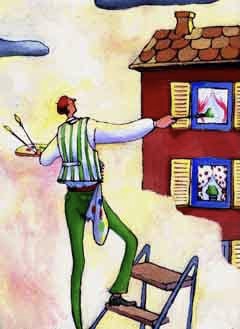
A painter bends close to a canvas, peering intently. A writer crouches over a keyboard. A sculptor scratches minute lines and ridges in stone. Each dab of the brush, each keystroke, each scrape of the chisel is executed with utmost concentration, as the artist pours their very soul into the action.
But every once in a while the artist will pull back. They will straighten their back, relax their limbs, even take a step or two back from their work to view it from a more distant vantage point. They will disengage their soul from their work, so as to see it from the outside rather than from within. For a long minute they will just stand or sit there, detached, even aloof. Then they will dive back in.
Imagine that a person wanted to put all the wisdom in the world in a single document—a document compact enough to be copied by hand from scroll to scroll, transported from place to place and transmitted from generation to generation for thousands of years. How would one go about doing it?
A preferred way would be to pick one’s words very carefully, so as to take advantage of each word’s multiple meanings. Constructing sentences so that they could be read several different ways, again imparting multiple messages. Using metaphors to tell a story inside a story, a law within a law, an idea within an idea. Giving each letter a numerical value and making certain letters were interchangeable with others, each word in the document would also be a code—actually a series of codes—conveying more layers of meaning. Embed allusions in the very shapes of the letters as flourishes of calligraphy, format spaces between the letters, words and paragraphs and the creation is almost done. Place the finishing touches to the document by using context and juxtaposition to convey even more information and the most complex document ever devised is complete.
That is what the Torah does and it can be especially seen in these last few Torah readings from the book of Exodus. (Actually from the whole of the Tanach.)

Let’s look at some specifics. In this week’s portion we are introduced to the project manager, so to speak, of the Tabernacle construction project. Betzalel is introduced as one who has been endowed with divine spirit of skill and a knowledge of every type of craft. What a resume! But look at the name and how it is constructed. Betzalel can be understood as meaning “in God’s shadow” as the Hebrew for shadow is tzel.
This idea of shadow is quite meaningful. Currently the world is witnessing the shadow, now, a full on attack of war in eastern Europe. The shadow has a negative connotation as in Carl Jung’s idea of the shadow as the projection by one’s subconscious, of the negative aspects of their personalities. That shadow’s negative side can also seen in the allusion of someone “living in someone’s shadow”, as if to say they are living an unrealized life.
According to Rabbi Address, classic Jewish thought of tzel (shadow) rejects the negative. The word is sometimes translated in the sense of shelter as in Psalm 91. This is shadow in the sense of being protected. Can this mean that no matter where a person is, they are under God’s protection? Hardly!
And before you go judging that statement – too many people have lived through moments in life when they were challenged to reflect, reimagine and readjust their life. The shelter was based on their own faith in a future and their perspective of self. Maybe that is what this really means. Maybe this passage is again reminding people that ultimately, they are their own Betzalel (foreman).
In some traditional commentaries Betzalel is seen as a metaphor for each of us. Each of us are in charge of creating our own sanctuary, our own life. The Tabernacle is symbolic of our life. We bring our gifts to our existence; our sense of the sacred, our ambition, our compassion, our life experience. Complex indeed, and there is a blueprint – you guessed it, for me it’s Torah, for others it might be the Bible. These are all the building blocks of life, and as a spiritually mature person, or those working towards that, we are able to examine what we have created and to consider what still needs to be done. Again, the tradition is to remind us that we are the architects of our own life. We, each of us, are our own Betzalel, endowed with the divine gift of spirit and life. Again we are reminded, choose wisely, choose the building blocks of sanctity, love, community and holiness.
 Confessions of a Cowtown Culturalist
Leave a comment